
Pie Medical Imaging
Dedicated to the efficient and effective analysis and visualization of medical images

For more than 20 years, Pie Medical Imaging has been dedicated to the efficient and effective analysis and visualization of medical images. In cooperation with clinical and research partners, we develop state-of-the-art solutions for our customers worldwide.

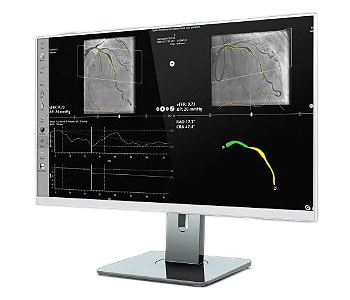
The CAAS vFFR system is an innovative technology allowing for the non-invasive physiological assessment of coronary lesions without the need for pressure wires or hyperemic agents.
Introduction
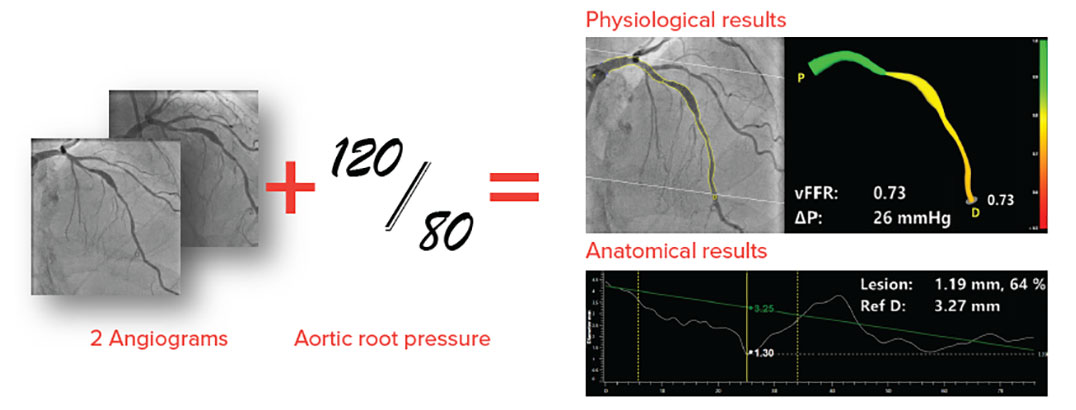
CAAS vFFR calculates the pressure drop in coronary vessels without the need of a pressure wire. The vFFR module builds a 3D reconstruction of two angiograms and assesses pressure-drop, resulting in a vFFR value. Additionally, the 3D reconstruction will enable assessment of severity and percentage of stenosis.
Why?
- No invasive pressure wire needed
- No hyperemic agent needed
- Easy, one-minute analysis
- Pre- and post stenting analysis
Strengths
- Only 2 angiograms needed
- X-Ray system independent
- Functional and anatomical measurements
- 510(k) Cleared and CE Marked
“In the FAST II trial,” said Joost Daemen MD, PhD, principal investigator , “We confirmed that vFFR as calculated using CAAS vFFR has a high diagnostic accuracy to detect FFR ≤ 0.80 in an international multi-center setting. vFFR is an accurate, fast and easy to use tool to assess coronary physiology.”
High diagnostic accuracy and good correlation with invasive FFR


[1] Published in EuroIntervention (2019; doi: 10.4244/EIJ-D-19-00466)
[2] Published in JACC Cardiovasc Imaging (2021; doi: 0.1016/j.jcmg.2020.08.006)
[3] Presented at EuroPCR 2021
[4] Between site operator and corelab
Broad clinical use
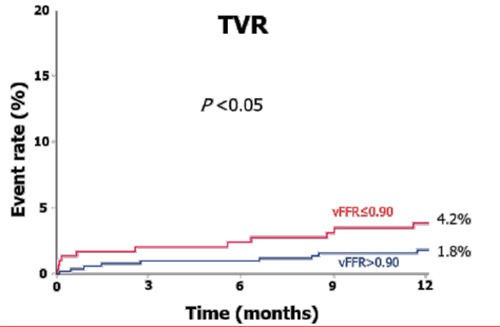
Optimize patient outcome using post stenting vFFR
assessment
- Lower rate of MACE for the patient group with a post stenting
vFFR value above 0.9 [5]
[5] Presented at TCT 2019
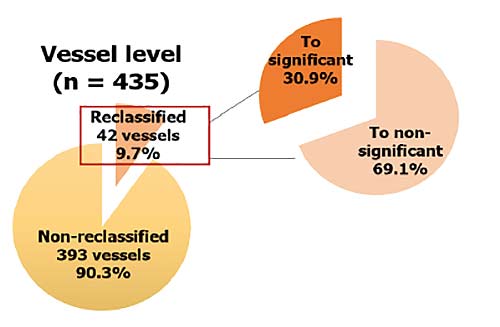
vFFR can be used for HeartTeam decision making.
- vFFR might impact the way HeartTeam consensus is
reached. As functional assessment of 3-vessel disease
using vFFR is used in stead of anatomical assessment. [6]
[6] Presented at TCT 2020
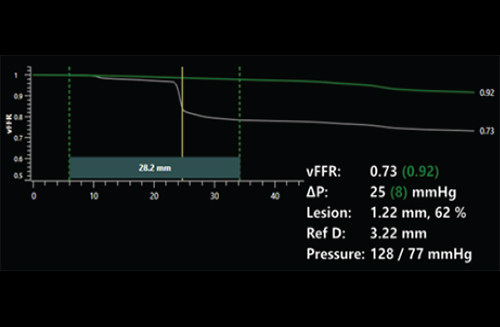
vFFR can be used to predict the effect of the treatment
using the residual pressure drop and residual vFFR value.
Conclusion
The 3D-QCA derived vFFR has a high linear correlation to invasively measured FFR, a high diagnostic accuracy to detect lesions with an FFR ≤ 0.80 and a low interobserver variability.
Pie Medical Imaging develops, produces and sells products in accordance with international accepted standards. CAAS Workstation
is FDA 510(k) cleared and MDD compliant (CE marked).